Where Is Thailand? Why So Many Backpackers Start There

Written by Jack Cyphus | Founder of CITTRA Collective

Travel Enthusiast & Cultural Lover

You can’t really talk about Thailand without talking about everything that comes with it. The food, the temples, the islands, the mountains, the history, the energy of Bangkok and the little everyday details that make the country feel so special. As a traveller who has visited Thailand multiple times and is still finding new reasons to go back, I wanted to write this piece to help others understand not just where Thailand is, but why it means so much to so many backpackers and explorers.

Exciting times! Researching where Thailand is can only mean good things, and if you’ve stumbled across my article, then it could also mean the start of the most unforgettable adventure of your life. If you are about to embark on a journey of self-discovery, then before you leave, it would be good to know that Thailand is in mainland Southeast Asia.

It is nestled between its wonderful neighbours Myanmar, Laos, Cambodia and Malaysia, and is much more than just the land of smiles. It offers a rare, unique mix of accessibility, affordability, beaches, cities, food, culture and so much more. There is a reason I have been 5 times and, as of writing this in March 2026, am going back for the 6th time in April 2026 and, like many fellow travellers and explorers, will not be disappointed. There is always something new to see, experience and discover, and for this reason so many backpackers begin their travels here.

Explore Southeast Asia

Select a pin to view key facts and figures.

Map of Southeast Asia
Country profile

Select a pin

Choose a country pin on the map to view population, capital, area and quick facts.

Country profile

Myanmar

Population: 54.8 million

Capital: Naypyidaw

Area: 676,578 km²

  • Borders India, China, Laos, Thailand and Bangladesh.
  • Bagan is one of its best-known historic sites.
  • The Irrawaddy River is a major waterway.
Country profile

Thailand

Population: 71.8 million

Capital: Bangkok

Area: 513,120 km²

  • Known for islands, temples and street food culture.
  • Shares borders with Myanmar, Laos, Cambodia and Malaysia.
  • Bangkok is one of the region’s major city hubs.
Country profile

Laos

Population: 7.7 million

Capital: Vientiane

Area: 236,800 km²

  • Laos is landlocked.
  • The Mekong is one of its most important rivers.
  • Known for mountain scenery and Buddhist culture.
Country profile

Cambodia

Population: 17.4 million

Capital: Phnom Penh

Area: 181,035 km²

  • Home to Angkor Wat.
  • Borders Thailand, Laos and Vietnam.
  • The Tonlé Sap is a major freshwater system.
Country profile

Vietnam

Population: 100.3 million

Capital: Hanoi

Area: 331,212 km²

  • Has a long coastline along the South China Sea.
  • One of the most populous countries in the region.
  • Major urban centres include Hanoi and Ho Chi Minh City.
Country profile

Malaysia

Population: 34.3 million

Capital: Kuala Lumpur

Area: 330,803 km²

  • Split between Peninsular Malaysia and Borneo.
  • Known for rainforests and multicultural cities.
  • Linked geographically with Thailand, Indonesia and Brunei.
Country profile

Singapore

Population: 5.9 million

Capital: Singapore

Area: 734 km²

  • A city-state at the tip of the Malay Peninsula.
  • One of the world’s major financial hubs.
  • Despite its size, it has a globally important port.
Country profile

Brunei

Population: 460,000

Capital: Bandar Seri Begawan

Area: 5,765 km²

  • Located on the island of Borneo.
  • One of the smallest states in Southeast Asia.
  • Has substantial oil and gas wealth.
Country profile

Philippines

Population: 117.3 million

Capital: Manila

Area: 300,000 km²

  • An archipelago of more than 7,000 islands.
  • One of the region’s largest populations.
  • Known for long coastlines and marine biodiversity.
Country profile

Indonesia

Population: 281.2 million

Capital: Jakarta

Area: 1,904,569 km²

  • The largest archipelagic country in the world.
  • The most populous country in Southeast Asia.
  • Includes major islands such as Java, Sumatra and Sulawesi.
Country profile

Timor-Leste

Population: 1.4 million

Capital: Dili

Area: 14,874 km²

  • Occupies the eastern part of Timor island.
  • One of Asia’s newest sovereign states.
  • Tetum and Portuguese are official languages.

Where Is Thailand on the Map?

So, before you set sail and get lost, we need to understand where Thailand is on the map. Thailand is in Southeast Asia, which is the part of Asia that sits below China and above countries like Indonesia. The whole region is made up of mainland countries and islands, and Thailand is one of the mainland ones.

Thailand sits in the middle of mainland Southeast Asia, and this is a primary reason why so many backpackers start their travels there. It is surrounded by Myanmar, Laos, Cambodia and Malaysia, putting it right in the heart and at the centre.

It is also definitely worth mentioning Thailand's seas and, although I am not going to go into a massive history lesson about these coastlines and how they affected and influenced the culture of Thailand - which they definitely did - it is important to understand that Thailand has two. On one side, you have the Gulf of Thailand and on the other, you have the Andaman Sea. These two coastlines are often the reason for the picture-perfect postcard paradise you see on social media.


Is Thailand Near Bali, Vietnam, Singapore or the Philippines?

I wanted to include this section here because if this is your first time planning a trip to Southeast Asia, then you are probably wondering about other countries that you plan on visiting too.

Thailand is technically far, but when you are travelling, you will soon realise just how close everything feels. This may seem like a weird contradiction and sound like I am just writing for poetic value, but it’s actually true.

The beauty of Southeast Asia is its connectedness. Let's take Bali, Indonesia for example, or the Philippines. These two countries are islands and therefore cannot be reached by land, but all over Southeast Asia there is a budget-friendly airline called AirAsia, which makes these island countries accessible daily. Yes, it costs a little more than other methods of transport, but it’s affordable, comfortable and fast. If you are even more of an adventure hunter, then I am sure you could find a ship too! I would love to hear any stories from you all on that.

Other countries like Vietnam and Singapore, or any of the surrounding countries of Thailand, are just a coach ride away, not literally, maybe you need to get two or three and maybe it takes a day, but the point is that it is readily available. The thing that shocked me the most is how easy it was to get a ticket to get a coach to go to another country. I remember we were in Cambodia in a place called Banlung. We stayed with this great guy called Puthea in his homestay and when it was time to leave, he knew a guy, who knew a guy, who got the tickets. Sometimes the journey can be unpredictable or a little bit unmanaged, but we also got to where we needed to be and didn’t get scammed once. Ticket sales are a really big form of income in the Southeast Asian countries and locals understand the need for travellers to get to where they need to be. They work on referral with legitimate sources to get your tickets and everyone is happy. One point I will make too, before this turns into the transport article, is that Southeast Asia, despite what people may think, is technologically advanced. Bookings can be made online too with ticket vendors like 12Go Asia.

The point of this section is to help you to understand that even if you are thousands of miles away from the next location on your itinerary, you are 9 times out of 10 going to be able to get there by plane, train, boat or automobile. There are options and a lot of them, assuming you are not in the middle of the jungle, but you will still be surprised.

What Is the Capital of Thailand?

The capital of Thailand is Bangkok and for most travellers this is where the trip really begins. It is the capital, the largest city in the country and the main arrival point for a huge number of international visitors, which is why so many backpackers find themselves stepping out into the heat here first before anywhere else. Bangkok sits on the delta of the Chao Phraya River, around 25 miles (40 km) from the Gulf of Thailand, and has been the capital of Siam, now Thailand, since 1782. 

But Bangkok was not always the capital, and that is part of what makes Thailand’s history so interesting. Before Bangkok, there was Thonburi, which became the capital in 1767 after the fall of Ayutthaya, and before that there was Ayutthaya, one of the great former capital cities of Thailand and now one of the country’s most famous historical sites. Go back even further and you get to Sukhothai, which was the capital of the first Kingdom of Siam in the 13th and 14th centuries. So when people think of Thailand’s capital as just Bangkok, they are right in the modern sense, but the story of Thailand has older capitals behind it too, and places like Ayutthaya and Sukhothai are a huge part of that story. 

Why Do Backpackers Go to Thailand First?

There is a reason why so many backpackers choose Thailand as their first destination. It is usually the first real entry point into the country because the airport is massive too and has many incoming international flights from all over the world, which makes it accessible and often keeps the ticket prices lower than Thailand's many other airports that deal with less volume.

The first time I travelled to Southeast Asia, I chose to start in Bangkok, Thailand. This wasn’t because of any reason except for accessibility. At this point, I didn’t know much about Thailand, Vietnam, or Malaysia. I was just an unknowledgeable adventurer, eager to get my feet on the ground and start exploring, and from my home in Manchester, UK, the flight was affordable and convenient.

Years passed and I have been back on a number of occasions. Each time landing on the tarmac in Bangkok and starting my adventure from there, but this time it was different. I knew about Thailand and I knew how easy it was to travel up and down the country or to get to the surrounding areas, but more importantly it was an easy way to get thrown into a culture that is so different to your own. It’s not the same being in a new place, not talking the language, not understanding something and having a hard time doing basic things. Travelling takes mental capacity sometimes and can honestly be exhausting, but Thailand has a way of easing people into the unknown.

Another thing that keeps travellers coming back to the start is the diversity of the landscape. I will talk more about this in detail later on, but because of the land size of Thailand, the coasts in the south and the mountains in the North, the country itself is so diverse that the experience you have in one place will be absolutely different to the experience you have in another place. The culture of the people changes from the north, south, east and west, and they have different foods, traditions and ways of life. All within the same wonderful country.

So just to summarise for you all with a nice simple list:

  • Thailand is super accessible from a lot of international countries
  • It is easy to travel around domestically and very diverse
  • It will ease you into the unknown and grow your confidence
  • People are super friendly

What Makes Thailand So Appealing for People

I think it goes without saying that Thailand is much loved by travellers, locals, holiday makers and all kinds of people in between. The reasons stretch far beyond the landscape-shifting diversity and the ability to travel with ease. Thailand has a rich culture and history which has been built over years, long before it was even called Thailand.

FUN TRIVIA - Thailand was only named Thailand in 1939 and it was known as Siam before that.

The Food

For those of you who have been a part of CITTRA Collective for some time, you will know that we love food. Food is the perfect way to experience a place and it's something that can change so drastically depending on where you are in the world. It's influenced by weather, trade, immigration and money, and Thailand’s food is a culture in itself. Some may argue that Thailand has some of the best food in the world. I would be pro to this.

The street food culture of Thailand, and a lot of Southeast Asia, is something to behold. Seriously, the choice you have from stall to stall is incredible. Imagine you are at home flicking through Netflix and you can't decide what to watch because you have too many options. Thailand's street food scene is like that, except most of it is actually decent.

And much like the landscape changes as you move around the country, the food changes too. Down in Southern Thailand, especially around the islands and coastal areas, you are going to find loads of fish, seafood and ingredients shaped by the sea. As you keep going further south, you also start to notice stronger Muslim influences in the food, which gives that part of Thailand its own identity again. Then up in Isaan in the northeast, things get a lot bolder. This is where your som tam comes from and where the food can be seriously spicy, punchy and packed with herbs. If someone has ever told you Thai food nearly blew their head off, then there is a fair chance they ate something from Isaan without realising it. Then up in Northern Thailand, the food changes again. You get dishes shaped by old Lanna traditions and nearby influences, and this is where you find khao soi, which loads of people call a noodle soup but is really much closer to a curry, and sai ua, which is one of my personal favourites. A proper herby, spiced grilled sausage. Then in Central Thailand, you get this brilliant mix of everything. Internationally recognised dishes, regional dishes, local spots, busy food scenes, and basically anything you could ever want.

The Scenery

The scenery is the same in the way that it keeps changing. One minute you are on an island with clear blue water, longtail boats, the most beautiful and ridiculous green-covered cliffs you'll ever see in your life and the possibility of it all ending by a box jellyfish, and then within some hours you can find yourself in the north surrounded by misty mountain jungles and roads that wind and wind for seemingly forever.

Down south is where you will find the island, the tropical, postcard kind of stuff that you see on Instagram. If you are searching for white sands, dramatic cliffs and beach-vibe towns, then this area will be where you are likely going to end up. This is the quintessential paradise that people talk about when referring to Thailand and believe me, it definitely lives up to its fame and glory.

For the trekkers, jungle lovers and rugged adventurers, you will likely be looking to the north. The air feels cooler here with the trees and greenery. This is where people go for motorcycle routes, to “get lost” in the wild and relax. Places like Chiang Mai and Chiang Rai offer different moods to the tropical south. You can go searching for secret waterfalls, go on a long guided trek to find incredible nature, witness the two most intricate temples in Thailand or just take it calmly with good food, drink and company.

Chiang Rai, Thailand

Two temples worth the trip on their own

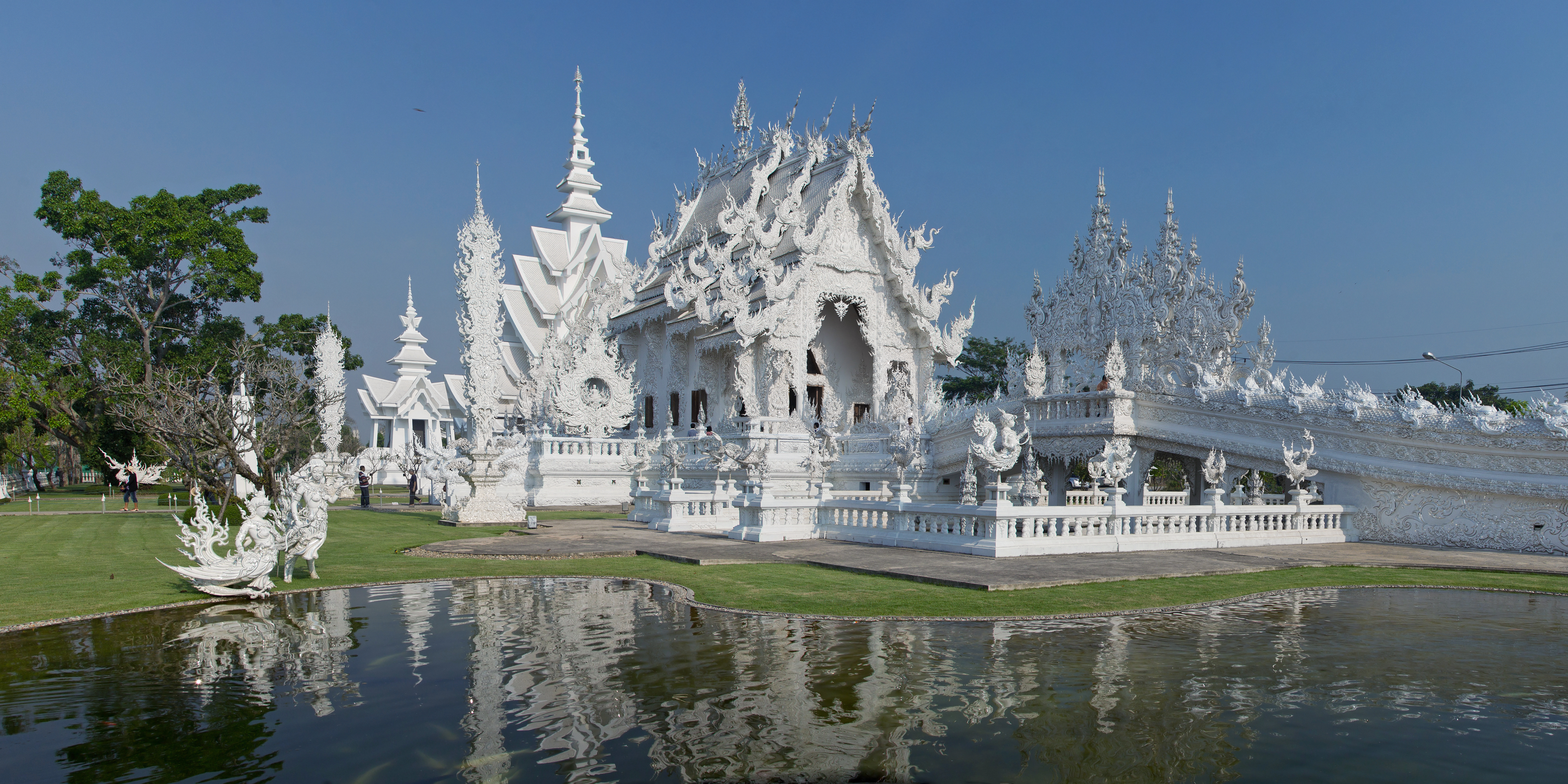
Chiang Rai is home to two of the most visually striking temples in Thailand. The White Temple and the Blue Temple offer completely different atmospheres, but both are unforgettable stops if you are exploring northern Thailand.

Wat Rong Khun, the White Temple in Chiang Rai, Thailand

Wat Rong Khun

The White Temple

One of Chiang Rai’s most famous landmarks, Wat Rong Khun is known for its brilliant white exterior, mirrored details, and surreal design. Created by Thai artist Chalermchai Kositpipat, the temple was rebuilt as a contemporary Buddhist art project and opened to visitors in 1997.

View on Google Maps
Wat Rong Suea Ten, the Blue Temple in Chiang Rai, Thailand

Wat Rong Suea Ten

The Blue Temple

Wat Rong Suea Ten stands out for its deep blue colour, gold detailing, and bold modern style. Built on the site of an older abandoned temple, the project was started by the local community, construction began in 2005, and the main temple building was completed in 2016.

View on Google Maps

Then there is Bangkok in the middle. I talk about Bangkok alone because it's an incredible city, huge, busy and loud, and the amount that it has to offer is a backpack travel all on its own. No matter what you travel for, Bangkok has something for you, whether it is art, food, history, party or whatever, it doesn't matter. You will find it here.

Of course Bangkok is not the only place in central Thailand. Once again, a common theme and the point I am making is that the scenery and the geography change here too. Places like Ayutthaya and Sukhothai give you a glimpse into the older and richer history of the country. Ancient capital cities, overgrown Tomb Raider temple ruins and the silhouette of relics that once were stand proudly all these years on in historical parks waiting for admiration.

The Culture

How can we not. CITTRA Collective is founded on travel, but the culture, the history and everything that makes countries unique is the reason for it all. It is very easy to talk about Thailand in terms of a holiday with beaches, food and all those things that we crave, but it would be irresponsible to not talk about the culture. I may be biased because at the end of the day I love Thailand from the very first day I spent there, but the culture is to be desired. It's special and has depth, symbols, colours, rituals and respect.

A massive part of Thai culture is not all just what you see. It is shaped by warmth, respect and community and you feel it when you are there. Let me tell you a story as an example.

We went to Lop Buri a few years back to visit. Lop Buri, for those of you that don't know, has a lot of history and culture but also is a city overrun by monkeys and obviously this for a traveller is something to marvel at. So we went unknowingly on a holiday called the King Narai Festival. Well, it turns out that shops were unable to sell, which we were not aware of, and we only found out because of a lovely family that owned a coffee shop. Instead of turning us away they invited us in. They gave us a drink and cooked us food. How incredible is that? I am from the UK and the chances of this happening are almost zero, but these people welcomed us and gave us some of the best hospitality.

This is how cultural aspects can shape the way that people act towards each other and I think this example is perfect.

Obviously you have temples and architecture, influences from immigration, spirituality and religion, but I think the thing that people really get hung up on, like the expats that end up finding a way to stay, is the respect and appreciation that people have for one another and when we talk about Thai culture this is a primary.

The Feeling of Constant Discovery

This is a big reason people connect with Thailand and travellers find themselves going back or starting here. For travellers, Thailand keeps your eyes busy and your mind stimulated and because of the style of hustle and bustle and the rapid growth of the country, no visit is the same. I try to go every year where possible and from the last 6 years the development and change that Thailand has seen has been astounding.

The interesting thing though is that no matter how many times you visit, even if it's the same location, you will likely see something new or experience something special. It may be something small like a new local food stall banging out a Michelin-star treat or it could be something substantial like the new train line they are building to get you to China in the space of hours.

You need time in this country to really experience what it offers and even then I'm not sure you ever will fully. This may seem like a sad situation to some of you but for travellers this is perfect. The ability to visit an incredible country time and time again and not run out of something new. What more could you really want?


Let's wrap things up

So, where is Thailand? Thailand is in mainland Southeast Asia, sat between Myanmar, Laos, Cambodia and Malaysia, with the Gulf of Thailand on one side and the Andaman Sea on the other. And for most travellers, the journey begins in Bangkok, where things get very real very quickly.

But like I have said throughout this article, Thailand is not just a place you point at on a map and that is the end of it. It is one of those countries that makes total sense for travellers. It is accessible, affordable, well connected and easy enough to help first-time backpackers find their feet, but it still gives you that proper feeling of adventure that people go looking for when they decide to get out into the world.

You can land in a huge chaotic city, head north into the mountains, go searching for old capital cities and temple ruins in the centre, then end up down south on islands with clear blue water and views you can only dream about. And all the way through that, the food changes, the scenery changes, the culture changes and the whole experience keeps giving you something new.

This is why so many backpackers start in Thailand, it just makes sense. It is not just beautiful. It is not just good for a holiday. It has depth to it. It has energy, character, history, culture and this incredible way of making you feel like there is always more to see.

So if you came here wondering where Thailand is, then you have probably not read up to this point. But it is in Southeast Asia and it is a gateway into the region for experiences and connections that will never be forgotten.


The trigger button is hidden. Click here to open popup.

Looking for more Thailand?

We have a whole page dedicated to Thailands history, culture and travel. If you are looking for more Thai content you can find it here.

Looking for more Thailand?

We have a whole page dedicated to Thailands history, culture and travel. If you are looking for more Thai content you can find it here.